

The first award for CSRD reporting quality.
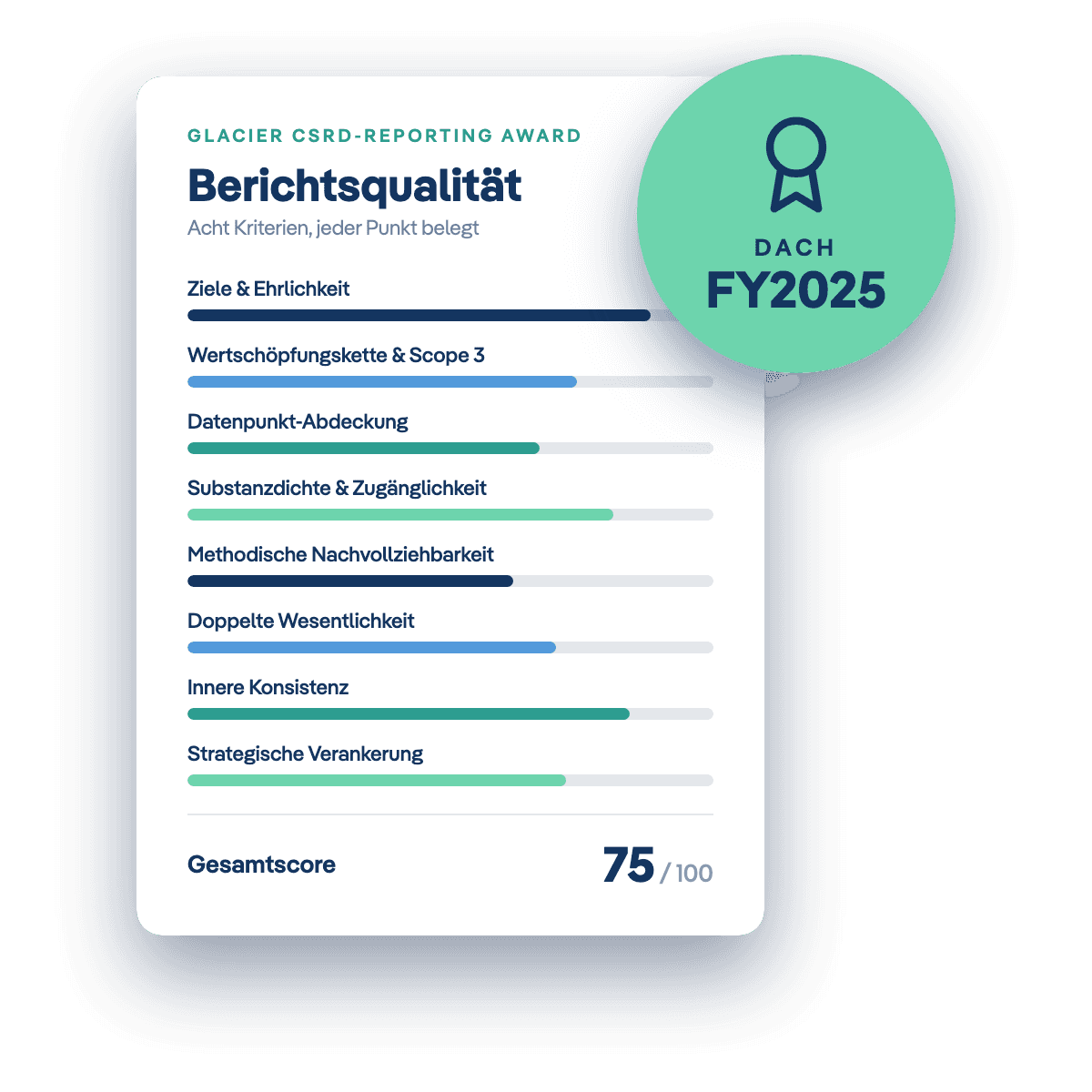
A full census instead of submissions: all reports in AT, DE and CH. Eight criteria, every point evidenced.
We assess reporting quality, not sustainability performance.
The idea
We assess how useful a report is for the people who read it. Not how audit-proof it is.
Existing formats are manual, slow and give the individual company no usable feedback. This is exactly where the CSRD Reporting Award DACH comes in.
What makes this award different.
No jury prize, no submission, no fee. Instead, a verifiable full census.
A full census instead of submissions
All of the roughly 250 to 400 companies in the DACH region that are required to report or report voluntarily are assessed. Nobody submits, and nobody can ask to be removed.
Evidence for every point
No score without a quote and page number. Every company receives its evidence trail. For the top 10, it is published.
Reader perspective instead of audit logic
We assess how useful a report is for its readers, not how audit-proof it is. So far, nobody assesses this gap.
Individual evaluation
Every assessed company receives its own scorecard: strengths, gaps, documented contradictions in figures and the comparison with its own cohort.
Around 30 awards instead of one
Rankings by size, country and sector, plus the Plain Language Prize, the Voluntary Reporter Prize and, from round 2, the Climber of the Year.
No commercialisation
No fees, no sponsored categories, no sale of rankings. The badge for ranked companies is free of charge.
Methodology
The eight criteria: each with an ESRS anchor, each with evidence.
Why no weights?
The criteria catalogue and weighting are published with the pre-registration in September 2026 and frozen afterwards.
Arrange a callDoes a report have quantified targets with a base year and interim targets? And how honestly does it deal with missed targets: named, explained and backed by countermeasures, or quietly removed?
No auditor assesses the ambition of targets or how missed targets are handled. At the same time, it is the question that investors, journalists and employees ask first.
You can persuade a jury. You have to evidence a methodology.
Pre-registration
Criteria, rubrics and the complete list of companies are published eight weeks before scoring begins, versioned and frozen afterwards. No subsequent adjustments.
Pilot before commitment
Before any public commitment, the methodology is tested on around 30 reports: do the criteria really measure different things? How stable are the results?
Five runs, blind scoring
Every report is assessed five times independently, without company name, logo and brands, as far as technically possible. The median is published, and the spread per criterion is disclosed.
External calibration
Ten reports are manually counter-scored in advance by external experts: analysts, sustainability journalists, procurement managers. The level of agreement is published.
Sensitivity analysis
Before publication, we check how stable the top positions remain under alternative weightings. The rank stability is published.
Appeals procedure
Every company receives its score and evidence three weeks before publication. Appeals concerning factual errors are reviewed, and corrections are logged publicly.
Pre-registration (Sep 2026)
The criteria catalogue and list of companies are published and frozen. Companies can apply to be included.
Calibration (Oct 2026)
External stakeholder representatives manually counter-score ten reports. The level of agreement is published.
Scoring (Oct to Nov 2026)
Full census of all reports: five independent runs per report, every point evidenced with a source reference.
Appeals window (Nov 2026)
All assessed companies receive their score and evidence trail three weeks before publication. Corrections are logged publicly.
Publication (Jan 2027)
Launch with a media partner: top 10, cohort winners, additional rankings, market findings and the complete, freely accessible methodology report.
What is published and what is deliberately not.
Freely accessible to everyone
Top 10 overall, top 3 per cohort, additional rankings, aggregated market findings (such as report length, tagging rate and target honesty in a DACH comparison) and the complete methodology report.
For every assessed company
The individual scorecard with evidence trail, list of gaps, documented contradictions in figures and peer comparison. It goes only to the company itself, never to the public.
For the ranked companies
The badge "Top 10 CSRD Reporting Award DACH 2027": free of charge, with a mandatory clarification text on reporting quality.
Never published
Bottom performers, bottom lists, negative mentions by name and the full ranking from position 11 onwards. Named at the top, private only at the bottom.
What the award does not measure and why that is intentional.
Not sustainability performance
No criterion measures how sustainably a company operates. We assess reporting quality, because a report that nobody can use makes even good performance invisible.
Not audit-proofness
Whether a report holds up to the assurance opinion is for the auditor to judge. The assurance level is shown as an accompanying finding, but does not feed into the score.
Not XBRL tagging
The tagging taxonomy is not final. An assessment would be unfair and outdated within a year. It is collected as a market finding, not counted in the score.
Not report length
Length alone is not a signal of quality. It only counts in relation to the information content. It is still included as a descriptive market finding.
Interested in the CSRD Reporting Award DACH?
Whether as a partner, as a company in the assessment universe or as an editorial team: talk to us about the award, the methodology and the timeline.
FAQ
Frequently asked questions about the CSRD Reporting Award DACH
The award measures reporting quality: how complete, transparent, consistent and usable a report is for its readers. It does not measure the company's sustainability performance or its audit-proofness. The former would be misleading, the latter is the auditor's job.