

ESRS 2026: what changes, when they apply and what you have to report
The revised ESRS have been published. Here you will find dates, changes and datapoints on one page.
ESRS 2026 in brief.
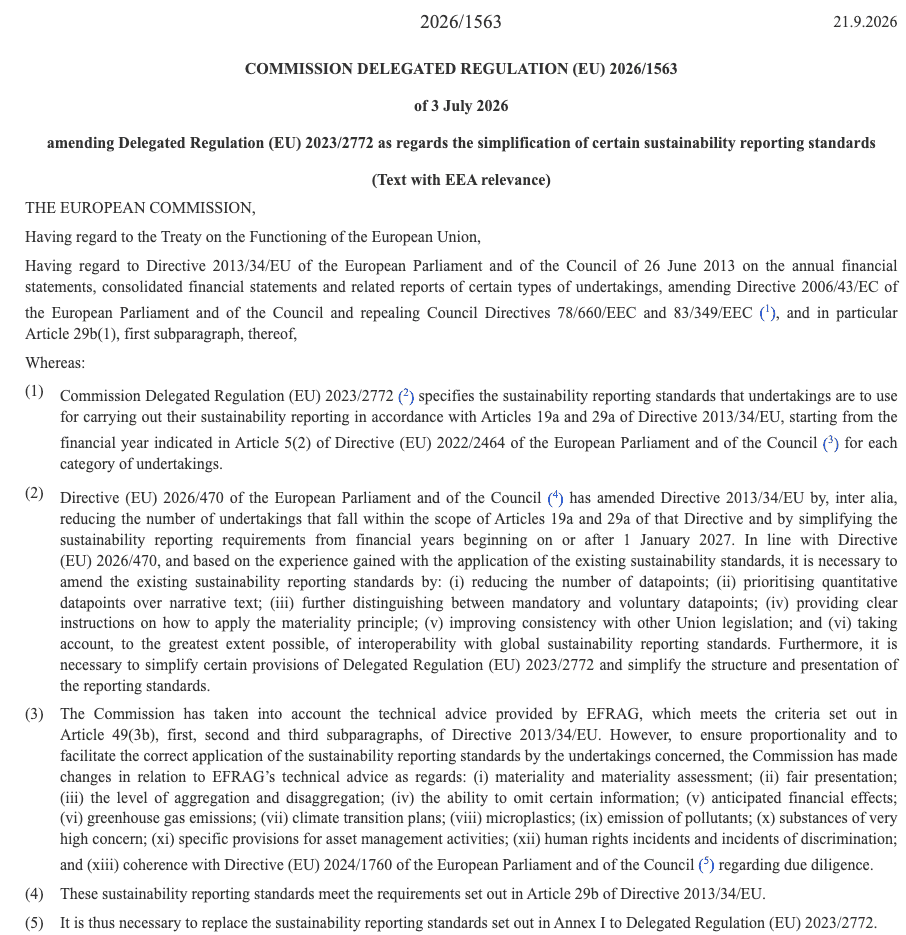
ESRS 2026 are the revised European Sustainability Reporting Standards. They were published in the Official Journal of the EU on 21 September 2026 as Delegated Regulation (EU) 2026/1563. They enter into force on 10 November 2026 and are mandatory for financial years starting on or after 1 January 2027. The number of mandatory datapoints falls by more than 60 per cent. However, many of these datapoints are merged into a few. The total number falls, but the overall scope does not fall to the same extent.
The facts in brief.
One legal act, two key dates and one choice. That is enough for a first overview.
ESRS 2026 in six lines:
- Legal act: Delegated Regulation (EU) 2026/1563, in the Official Journal since 21 September 2026.
- Replaces: the 2023 ESRS (Set 1, Delegated Regulation (EU) 2023/2772).
- Application: directly applicable in all Member States. No national transposition is needed.
- Mandatory: for financial years beginning on or after 1 January 2027.
- Financial year 2026: a choice between the old version, the new version and the old version with eight reliefs.
- Datapoint list: EFRAG draft of 28 August 2026, final version announced for the end of 2026.
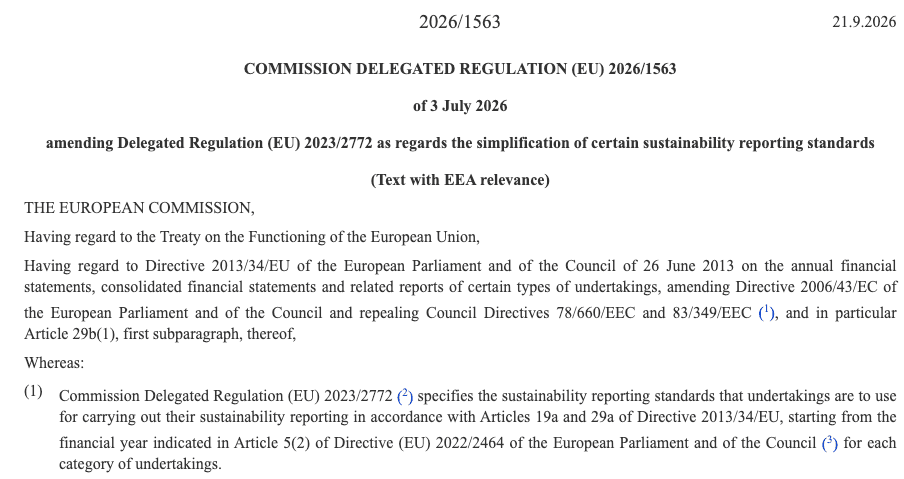
3 July 2026
The European Commission adopts the revised ESRS.
28 August 2026
EFRAG publishes the draft of the new datapoint list as an Excel file. Feedback can be submitted until 23 October 2026.
21 September 2026
Publication in the Official Journal of the EU, in all official languages.
10 November 2026
ESRS 2026 enter into force. The consultation on the XBRL taxonomy ends on 11 November.
End of 2026
EFRAG intends to present the final datapoint list. The German version is expected to be corrected by then.
1 January 2027
From this date, ESRS 2026 are mandatory for all financial years beginning on or after this day.
Three options for financial year 2026.
Previous ESRS
You report in full under the 2023 ESRS one more time. This makes sense if your data collection and report structure for 2026 are already in place.
ESRS 2026 in full
You apply the new version voluntarily one year early. You avoid changing over twice, but you need clarity with your auditor early on.
Previous ESRS plus eight reliefs
You stay with the old version and use exactly eight specified reliefs from ESRS 1 of the new one. You are not allowed to mix freely.
The eight reliefs at a glance.
Top-down approach
The double materiality assessment may be built from the top down. ESRS 1, para. 27.
No undue effort
Limits on gathering information and on data requests in the value chain. Paras 32 and 33.
Acquisitions and disposals
Separate rules for parts of the business that are added or removed during the reporting year. Paras 74 and 75.
Non-material activities
Relief on metrics for activities that are not material. Para. 90.
Partial value chain coverage
Metrics may cover the value chain in part. Para. 91.
Joint operations
Relief for joint operations without operational control. Para. 92.
Taxonomy disclosures
The EU Taxonomy disclosures may be placed in a separate appendix. Para. 106.
Executive summary
The report may open with an executive summary. Para. 110.
Scope of the new standards, according to the EFRAG draft of 28 August 2026
How the ESRS 2026 datapoints are distributed.
Always applies
ESRS 2 General disclosures: 94 datapoints
Basis for preparation, governance, strategy, and impacts, risks and opportunities. Every company subject to reporting makes these disclosures.
Environment
E1 to E5: 148 datapoints
E1 Climate change (87), E2 Pollution (20), E3 Water (11), E4 Biodiversity and ecosystems (12), E5 Resource use and circular economy (18). Only for topics that are material for you.
Social
S1 to S4: 94 datapoints
S1 Own workforce (52), S2 Workers in the value chain (15), S3 Affected communities (15), S4 Consumers and end-users (12). Only for topics that are material for you.
Governance
G1 Business conduct: 23 datapoints
Corporate culture, political influence and relationships with suppliers. To be reported only if the topic is material for you.
Which datapoints apply to you?
The ESRS 2026 catalogue is not your mandatory scope. What you report follows from the topics that are material for you.
This is what your materiality assessment decides:
- ESRS 2 always applies: basis for preparation, governance, strategy and the management of impacts, risks and opportunities.
- Topical standards apply only to material topics. If a topic is not material, its datapoints do not apply.
- Policies, actions and targets appear only once in the catalogue, but you describe them separately for each material topic.
- Conditional datapoints apply only if the condition is met for your company.
- Transitional provisions defer individual disclosures in the first years.

Read more
ESRS 2026 in detail.
Are you currently moving to ESRS 2026?
Using your own report, we show you which datapoints apply to you and where evidence is still missing.
Frequently asked questions
ESRS 2026 in eight questions.
Clarify your reporting scope
We go through with you which ESRS 2026 datapoints apply to your company.
Book a demoESRS 2026 are the revised European Sustainability Reporting Standards. They replace the first version from 2023 (Set 1) and were adopted as Delegated Regulation (EU) 2026/1563. Companies that fall under the CSRD prepare their sustainability report in accordance with these standards.